Hyundai Formula 1 Concept | Turning a perception gap into a public proof system
Hyundai has already done much of the difficult work of changing what it makes. The remaining problem is that public perception does not update at the same speed. This independent concept explores Formula 1 as a way to make Hyundai's engineering, design and performance progress visible through repeated public competition, then builds the team identity, communications and fan experience around that idea.
At a glance
Project: Independent Hyundai Formula 1 concept
Role: Creative strategy, brand strategy, positioning, identity direction, audience strategy and experience concept
Creative platform: Progress Under Pressure
Strategic objective: Close the gap between present-day Hyundai and inherited perceptions of the brand
Status: Independent concept, not commissioned by or affiliated with Hyundai Motor Company, Formula 1, the FIA or any associated organisation

Hyundai has changed faster than people have changed their minds
Hyundai already recognises the problem. Its UK marketing has spoken openly about moving from a value-focused brand towards a premium volume contender associated with design, innovation and performance. Hyundai Motorsport describes competition as instrumental in shifting global perception of the company.
The product evidence is substantial. IONIQ 5 N won 2024 World Performance Car. Hyundai has won WRC manufacturers' championships, a WRC drivers' title and multiple touring car championships. Yet a 2026 Top Gear review of the regular IONIQ 5 could still casually reference "badge snobs" questioning its price.
That gap interested me more than the prospect of simply designing an F1 car.
Reputation has latency. People can absorb new information about a company while continuing to reach for an old mental shortcut. Changing that shortcut requires enough evidence, over enough time, that the old version becomes harder to maintain.
Formula 1 happens to manufacture exactly that kind of evidence every weekend.
The strategic idea came before the racing livery
I approached the project through the same applied creativity model I use elsewhere: observe what is actually happening, question the inherited assumption, connect the evidence, reframe the opportunity, then apply it.
That meant starting with a more useful question than "What would Hyundai look like in Formula 1?"
The question became: what could Formula 1 do for Hyundai that another global campaign could not?
The answer was scrutiny.
Qualifying, race pace, reliability, engineering decisions and pit work all happen publicly against Ferrari, Mercedes, McLaren, Audi, Cadillac and the rest of the grid. Hyundai can make claims about itself elsewhere. In Formula 1, other teams are actively trying to disprove them.
That led to the creative platform:
PROGRESS UNDER PRESSURE
Hyundai Formula 1 becomes a highly visible test of the word already sitting at the front of Progress for Humanity.

I kept Hyundai, rather than N, at the centre
Hyundai N gives the concept substantial performance credibility. Its engineering knowledge, driver-focused philosophy and Rolling Lab approach provide a convincing route into Formula 1 development.
I still chose Hyundai Formula 1 Team as the front-facing constructor.
An N-led team would concentrate much of the reputational benefit inside a specialist performance brand. The more interesting opportunity is to change what the Hyundai name itself can mean.
There is also a useful distinction from Genesis Magma Racing. Genesis can use endurance racing to build luxury performance heritage. Hyundai can take a much broader proposition into Formula 1: one of the world's largest mainstream automotive brands putting its engineering capability on the same timing screens as some of the industry's most prestigious names.
Millions of people can actually buy a Hyundai. That gives its participation a different cultural and commercial texture.
The identity treats heat as information
The visual system grew directly from the strategic idea.
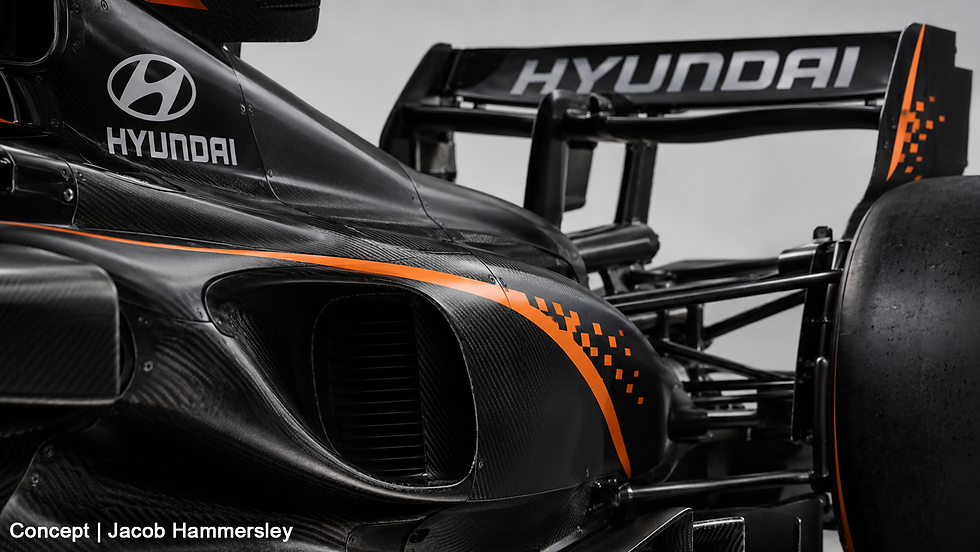
Pressure Orange, #F2601F, appears against Carbon Black, Deep Burgundy and Burnt Red. I deliberately avoided using orange as one enormous colour field because McLaren already has a famous relationship with papaya.
Here, orange behaves more like a warning light.
It appears where energy feels concentrated: leading edges, aerodynamic cuts, cooling exits, seams and pieces of live information. Hyundai's Parametric Pixels then become more active through the car, particularly towards the rear, as though the machinery is beginning to break into data.
The effect should be recognisably Hyundai without turning every existing Hyundai brand asset into racing decoration.
The Proof Mark gives the identity somewhere to go
A completely new Formula 1 team has a slightly absurd branding problem: designers can make it look historic before it has completed a lap.
I preferred the empty space.
The Proof Mark starts as a largely dormant Parametric Pixel grid. Championship rounds gradually activate it, while significant firsts create permanent marks: first race, first points, first Q3, first podium, first pole, first win.
Each mark is generated from the event, circuit and achievement.
That changes the role of the identity over time. A pixel on a jacket might eventually refer to a race somebody remembers staying up until 2am to watch. A wall inside hospitality becomes more interesting because several years earlier it was almost blank.
Hyundai's existing pixel language starts recording sporting memory rather than merely signalling modernity.

The launch begins with an empty record
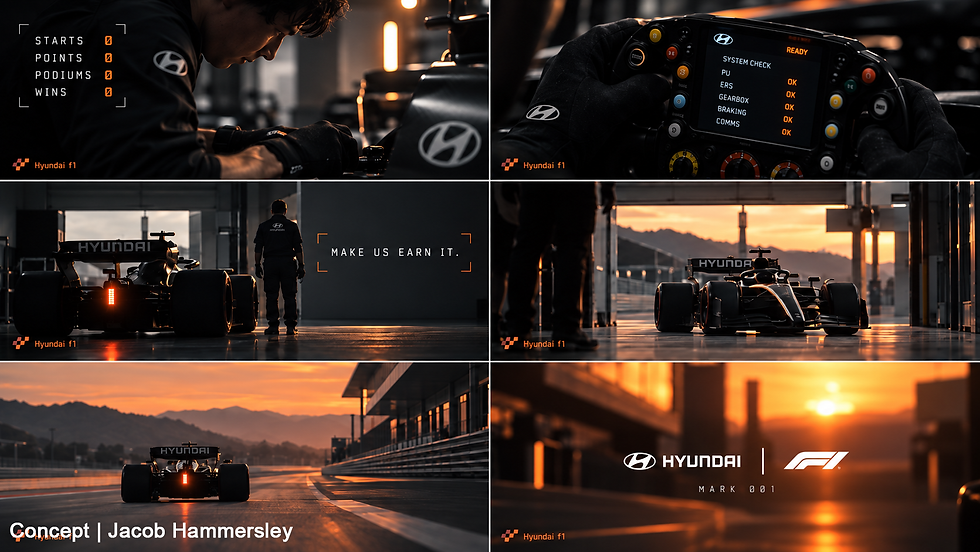
The launch idea, RUN 001, uses Hyundai's lack of Formula 1 history as useful material.
STARTS 0POINTS 0PODIUMS 0WINS 0
Then:
MAKE US EARN IT.
The first authorised running of the car becomes the first event worth recording. Cameras stay close to the engineering work at Namyang. Temperatures, battery state, timestamps and system status replace the usual heroic voiceover.
The car moves. Proof Mark 001 appears.
There is something more attractive about beginning with zero than borrowing significance from somebody else's racing nostalgia.
Communication keeps the same discipline
Every race generates a Proof File recording the result, the most important improvement, the weakness that mattered and what comes next.
A poor weekend still produces a useful piece of communication.
That matters because Formula 1 teams have a habit of making P14 sound like an incredible journey. Hyundai would gain more from being unusually clear about what happened.
The same principle shapes audience strategy. Established fans get technical substance. Newer fans can arrive at chapter one and understand the significance of Hyundai's first point because they were there when it happened. Gaming, fashion, music and design then use the racing itself as source material.
A tyre temperature map can become a poster. Telemetry can become sound. A first podium can generate a garment that literally could not have been designed the week before.

Success would be measured as a change in what Hyundai means
Formula 1 already provides extraordinary reach, so visibility tells us relatively little.
I would measure what I called The Perception Delta: longitudinal movement across major F1 markets in associations with performance, engineering capability, desirability, technological leadership and consideration, with Hyundai F1 exposure tracked separately.
The useful question is straightforward:
How far has public perception moved towards the Hyundai that actually exists?
That measurement also keeps the creative idea honest. A beautiful car, strong merchandise sales or a large social following could all be valuable, while still failing to solve the problem that justified Formula 1 in the first place.
For me, that is where the concept becomes interesting. Formula 1 gives Hyundai a communications environment in which the evidence remains unfinished. A brilliant weekend strengthens the story. A reliability failure complicates it. A first podium changes what the Proof Mark means. Nothing stays theoretical for long.
Progress Under Pressure is therefore designed as a brand system that can absorb the awkward parts of competition as readily as the successful ones. That feels much closer to how reputation actually changes: slowly, publicly, and through enough accumulated evidence that the old assumption eventually becomes harder to defend.
This is an independent speculative concept created by Jacob Hammersley and was not commissioned, endorsed or produced in affiliation with the brand featured.